Physical Address
304 North Cardinal St.
Dorchester Center, MA 02124
Physical Address
304 North Cardinal St.
Dorchester Center, MA 02124

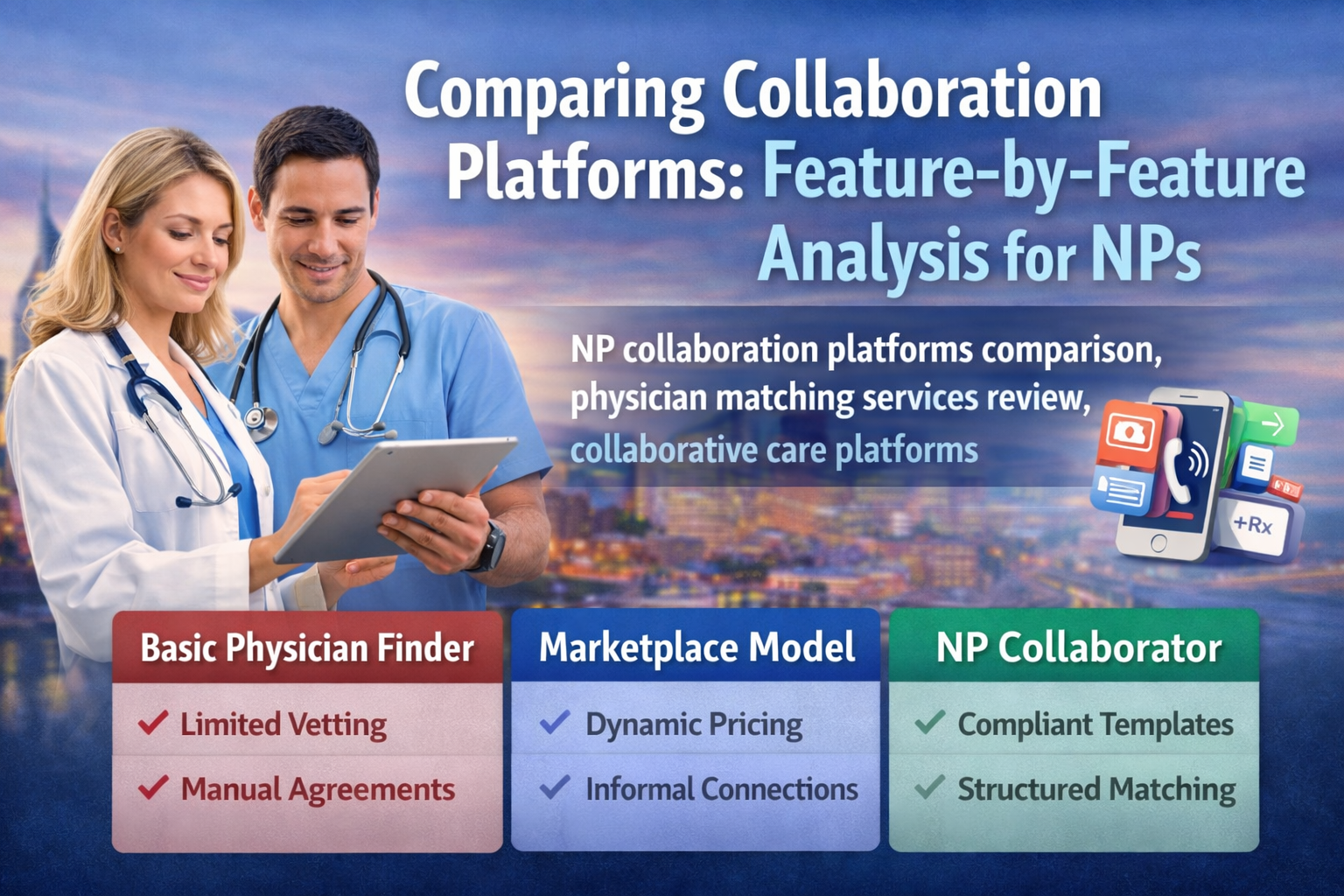
As more states continue to regulate nurse practitioner (NP) practice through collaborative or supervisory models, the demand for reliable physician matching services and structured collaboration platforms has grown significantly. Whether you’re launching a new practice, expanding into a restricted state, or transitioning to independent contracting, choosing the right NP collaboration service can directly impact compliance, workflow efficiency, and profitability.
In this detailed platform comparison, we break down the essential features NPs should evaluate when reviewing collaboration platforms — including physician matching services, compliance support, technology integrations, and pricing transparency. We’ll also include a focused look at NP Collaborator as part of this analysis.
In reduced or restricted practice states, nurse practitioners often need a formal collaborative agreement or supervisory arrangement with a licensed physician. But beyond simply “finding a doctor,” modern collaboration platforms now offer:
The difference between platforms often lies in how deeply they support compliance, how transparent their pricing is, and whether they provide operational support beyond the initial match.
Below are the most important features to evaluate when comparing healthcare collaboration platforms.
What to Look For:
Why It Matters:
A broad, vetted physician network reduces delays and ensures the collaborating physician understands state-specific regulations.
Evaluation Insight:
Platforms that simply provide a contact list differ greatly from those that actively vet physicians and handle agreement structuring.
Key Considerations:
In states like Georgia, Tennessee, New Jersey, and Indiana, regulatory language in collaborative agreements must be precise. A platform that understands state board nuances provides a major risk-reduction advantage.
Red Flag:
If a platform does not provide structured compliance documentation or legal guidance, the NP may bear full regulatory responsibility alone.
Advanced collaboration services offer:
Basic services may simply connect the NP and physician, leaving contract management entirely manual.
For NPs operating multi-location practices, built-in contract management can prevent costly lapses.
Some modern collaborative care platforms now include:
For NPs running hybrid or fully remote practices, tech integration can be a deciding factor.
When comparing NP collaboration services, carefully review:
Transparent pricing prevents long-term financial surprises — especially for start-up practices.
Among physician matching services, NP Collaborator positions itself as a structured physician matching and collaboration facilitation platform designed specifically for nurse practitioners.
Unlike general healthcare staffing marketplaces, NP Collaborator emphasizes regulatory-compliant collaborative agreements rather than temporary staffing.
| Feature | Basic Physician Finder | Marketplace Model | Structured Platform (e.g., NP Collaborator) |
|---|---|---|---|
| Physician Vetting | Limited | Variable | Structured |
| Compliance Templates | Rare | Limited | Included |
| Agreement Management | Manual | Partial | Structured |
| Multi-State Network | Limited | Moderate | Broad |
| Pricing Transparency | Variable | Often dynamic | Typically clear |
| Ongoing Support | Minimal | Limited | Ongoing facilitation |
Before committing, ask:
Choosing an NP collaboration platform is not just about finding a supervising physician — it’s about long-term compliance, operational stability, and scalability.
For NPs expanding into restricted or reduced authority states, structured platforms like NP Collaborator may provide more regulatory alignment compared to informal physician finder services. However, each NP’s business model, specialty, and growth plan should guide the final decision.
A careful, feature-by-feature evaluation ensures you’re not just meeting minimum regulatory requirements — but building a sustainable and compliant practice model.