Physical Address
304 North Cardinal St.
Dorchester Center, MA 02124
Physical Address
304 North Cardinal St.
Dorchester Center, MA 02124

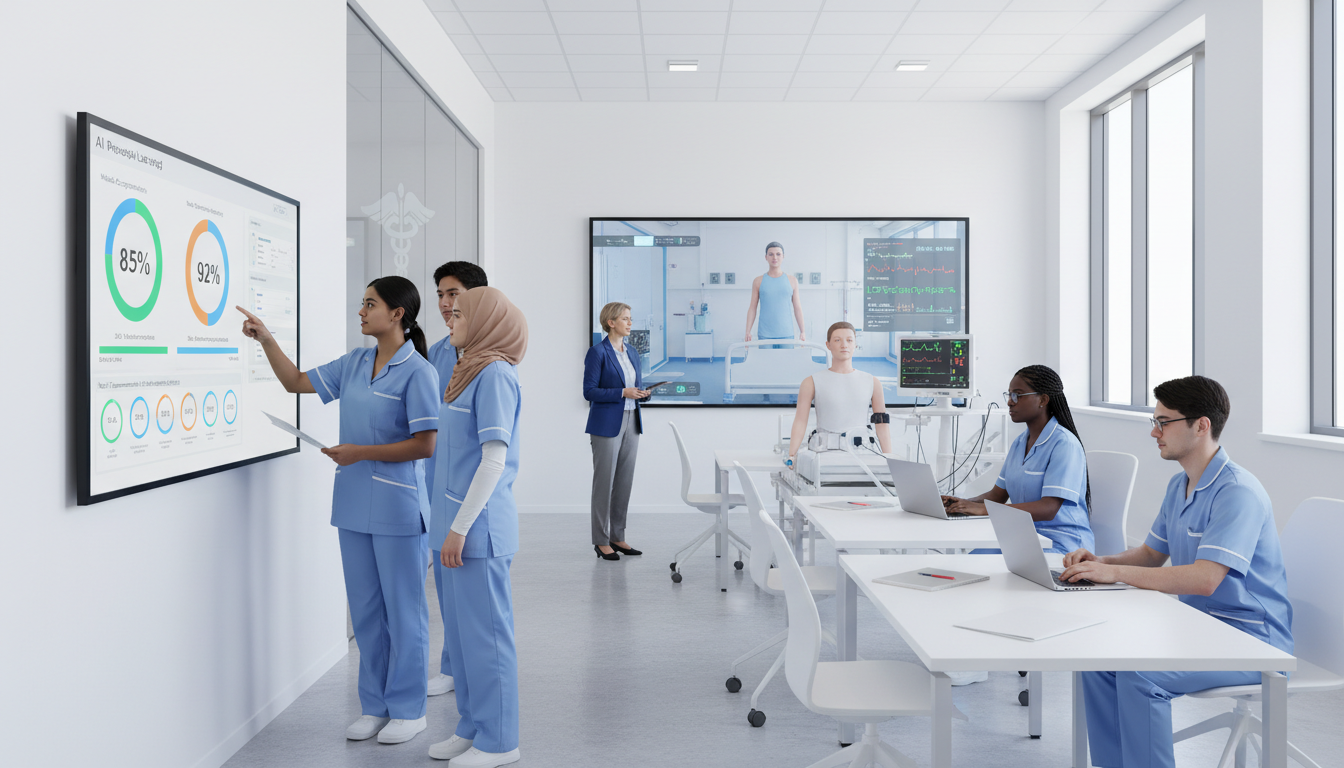
Nursing education is undergoing one of the most profound shifts in its history. As healthcare becomes more complex and data-driven, educators are under pressure to prepare nurses who are clinically competent, technologically fluent, and ready to adapt to rapidly changing care environments. In this context, artificial intelligence (AI) is emerging not as a buzzword, but as a powerful set of tools reshaping how we teach, assess, and support nursing students.
For organizations like pennanurses.org, which are deeply invested in the future of nursing and advanced practice, understanding AI’s role in education is critical. From adaptive learning platforms to high-fidelity simulations and smarter assessment systems, AI is helping educators personalize learning, improve student outcomes, and innovate curricula in ways that were not possible even a few years ago.
This educational feature explores how AI nursing education and nursing technology are transforming the training of the next generation of nurses, with a special focus on nurse practitioner (NP) programs and an interview-style perspective from an NP educator on AI-enhanced learning in NP graduate programs.
The need for change in nursing education isn’t theoretical—it’s urgent:
AI in nursing education addresses these pressures by providing:
Far from replacing educators, AI is functioning as an intelligent assistant—augmenting human expertise, not substituting for it.
Traditional nursing curricula often move students through content in a linear way, regardless of prior knowledge, learning pace, or clinical experience. AI-enabled adaptive learning platforms are changing this model.
AI-driven systems continuously analyze:
Based on this data, the platform dynamically adjusts:
For example, a student struggling with fluid and electrolyte balance might automatically be assigned:
Another student who has mastered these topics might be routed more quickly to complex multi-system failure scenarios.
High-fidelity simulation has long been a cornerstone of modern nursing education. AI is adding a new dimension by making simulations more responsive, predictive, and realistic.
AI-enhanced nursing simulation platforms can:
Instead of a scripted manikin with fixed responses, students may interact with a virtual patient whose condition improves or deteriorates based on assessment quality, clinical reasoning, prioritization, and timely interventions.
Educational AI tools embedded in simulation environments can:
These analytics support formative feedback, allowing students to understand not just whether they passed a scenario, but how they performed compared to expected standards or peers.
AI is also reshaping student assessment—moving beyond traditional exams toward a more nuanced view of competence.
Using AI, educators can:
While human oversight remains crucial, AI can reduce grading time and highlight responses that warrant closer review—such as those showing unsafe reasoning or potential knowledge gaps.
Educational AI systems can:
For nursing programs focused on diversity in the workforce, this can be particularly impactful—supporting students from varied backgrounds with timely, individualized assistance.
AI is also influencing curriculum innovation in nursing and NP education.
AI-powered tools can:
This ensures that nursing curricula remain relevant and grounded in current standards of care.
AI can help program leaders:
For institutions like those connected with pennanurses.org, this kind of data-informed curriculum planning helps ensure that graduates are prepared for real-world practice and advanced roles.
AI in nursing education does not exist in isolation—it is part of a broader movement toward nursing technology integration.
Key technologies that often incorporate AI include:
These tools bridge the gap between school and practice, helping students become comfortable with the digital ecosystem they will encounter as licensed nurses and NPs.
To better understand how AI is influencing NP education specifically, consider this interview-style perspective with a fictional but representative NP faculty member, Dr. Maya Thompson, DNP, FNP-BC, who directs an NP graduate program utilizing AI-enhanced learning.
Dr. Thompson:
“We’ve always valued clinical reasoning and holistic care, but AI has helped us see how our students think in real time. With adaptive learning platforms, we can track patterns in diagnostic reasoning—where students consistently miss key differential diagnoses, or where they anchor on one possibility too early. It gives us a level of visibility we simply didn’t have with traditional exams alone.”
Dr. Thompson:
“We use AI-powered case platforms where the virtual patient evolves over time. For example, an NP student might see a 52-year-old with chest discomfort in a primary care setting. The AI-driven system adjusts the case based on their history-taking and exam. If they miss red flags, the patient might return with more severe symptoms, prompting a deeper conversation during debrief about missed opportunities and safety.
We also use an adaptive pharmacology module. It personalizes drug-related questions based on prescribing patterns and errors from prior assessments. That’s been incredibly helpful in solidifying safe prescribing.”
Dr. Thompson:
“Our cohorts are diverse—some students have years of ICU experience, others come straight from med–surg or community health. AI helps tailor the learning journey. A student strong in cardiology might move quickly through foundational content and spend more time in endocrine or mental health scenarios where they’re less confident. Meanwhile, another student might need repeated practice in cardiovascular risk assessment.
The key is that students no longer feel like they’re being ‘held back’ or ‘left behind’—the system meets them where they are.”
Dr. Thompson:
“We address that head-on. In our curriculum, AI is framed as a tool, not an authority. We emphasize clinical judgment, ethics, and the importance of questioning algorithmic bias. In debriefs, we often ask, ‘What would you do if the AI recommendation didn’t match your clinical impression?’ That’s a crucial professional skill.”
Dr. Thompson:
“Initially, some are anxious—especially those who worry that AI is ‘grading’ them. Once they see that the data is used to support their growth, not punish them, they usually become enthusiastic. Many tell us they appreciate seeing immediate feedback and personalized recommendations; they don’t have to wait weeks for an exam grade to know where they stand.”
Dr. Thompson:
“I think we’ll see NPs who are more data-literate, more comfortable navigating decision-support tools, and more aware of how technology influences care quality. But we also emphasize the human side—communication, empathy, cultural responsiveness. AI actually gives us more time and insight to focus on those dimensions, because it takes some of the repetitive cognitive load off both students and faculty.”
While the potential of educational AI in nursing is significant, it brings important challenges.
For nursing programs, professional organizations, and educational partners such as pennanurses.org, the path forward includes:
AI is not a distant future concept; it is already reshaping how we teach, learn, and assess in nursing and NP programs. Through personalized learning, advanced nursing simulation, smarter student assessment, and thoughtful curriculum innovation, AI can help educators prepare a workforce of nurses and nurse practitioners who are both clinically excellent and technologically fluent.
For the next generation of nurses, learning in AI-enhanced environments will feel normal. The challenge—and opportunity—for today’s educators and organizations like pennanurses.org is to guide this transformation with intention, equity, and an unwavering commitment to the humanistic core of nursing.
If we do this well, AI in nursing education will not replace the art and science of teaching; it will amplify it—helping us train professionals who can lead in a healthcare system increasingly shaped by data, technology, and the enduring need for compassionate care.