Physical Address
304 North Cardinal St.
Dorchester Center, MA 02124
Physical Address
304 North Cardinal St.
Dorchester Center, MA 02124

The headlines are provocative: “AI Outperforms Doctors in Diagnosing Breast Cancer,” “Machine Learning Algorithm Predicts Heart Disease Better Than Cardiologists.” It’s natural to wonder if artificial intelligence is poised to replace physicians. But that’s not what the technology is actually doing—and it’s not what will happen. Instead, we’re witnessing something more nuanced and powerful: the emergence of AI as a clinical decision support tool that enhances human expertise rather than replacing it.
Today’s healthcare reality isn’t “AI vs. human doctors”—it’s “AI and human doctors working together.” Understanding where this collaboration exists today, what it accomplishes, and what it requires will help us navigate this evolving landscape.
To understand how AI supports clinical decisions, we need to be precise about what these systems actually do. Clinical decision support AI typically excels in narrow, well-defined tasks:
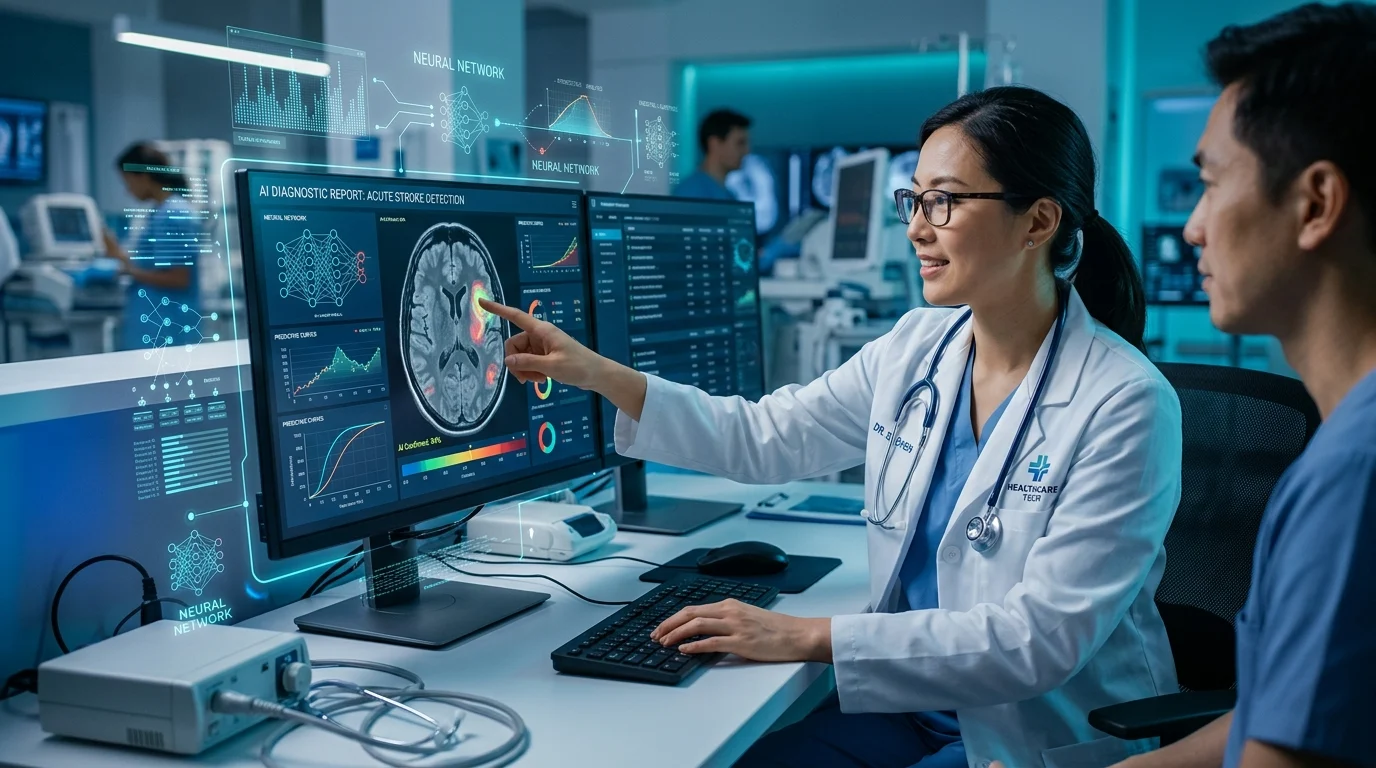
Importantly, these systems are tools—not decision-makers. A radiologist doesn’t look at an AI-flagged imaging finding and automatically accept it. The radiologist interprets the image, considers the clinical context, integrates knowledge about the patient, and makes the diagnosis. The AI is a second set of eyes, a pattern recognizer that reduces the chance of missed findings.
Medicine is fundamentally about uncertainty, complexity, and individual variation. Here’s why AI alone cannot replace physician decision-making:
Sepsis Detection: Sepsis is deadly—mortality increases with every hour of delay in treatment. AI systems analyze electronic health records in real-time, identifying subtle patterns that suggest sepsis developing. They alert clinicians, who then confirm diagnosis and initiate treatment. This support has reduced sepsis mortality in some hospitals.
Imaging Interpretation: Radiologists are inundated. In many settings, hundreds of imaging studies queue for interpretation. AI systems can prioritize worklist—flagging the most concerning studies for immediate review. They can also serve as a secondary reader, reducing missed findings. Studies show that radiologist + AI performs better than radiologist alone or AI alone.
Drug Interaction Screening: Pharmacists use AI-enhanced systems to flag dangerous drug combinations before prescriptions fill. The AI catches interactions a busy clinician might miss; the pharmacist confirms the interaction is relevant in that specific patient’s context.
Diagnostic Support in Primary Care: General practitioners manage an incredibly broad scope—they might see 30 patients in a day with varied complaints. AI tools that help organize differential diagnoses (potential conditions that could explain the symptoms) reduce diagnostic error, particularly for less common conditions.
Predictive Analytics in Chronic Disease: For patients with heart disease, diabetes, or COPD, AI can identify those at highest risk for decompensation or hospitalization. This allows clinicians to prioritize interventions, increase monitoring, or adjust medications proactively.
Another critical way technology supports clinical decision-making is by facilitating better collaboration between healthcare providers. Clinical decisions are increasingly made collaboratively—physicians consulting specialists, nurse practitioners working with collaborating physicians, teams coordinating across settings.
Technology platforms that streamline these collaborations improve decision quality. When providers can easily access shared information, communicate efficiently, and have clear role definitions, the entire decision-making process becomes sharper. Consider collaborative practice arrangements where a nurse practitioner manages patient care with physician collaboration. Clear, efficient collaboration channels—whether through structured communication platforms or well-organized practice agreements—enable faster consultation, shared expertise, and better-informed decisions.
Platforms designed to facilitate healthcare professional collaboration recognize that decision-making quality improves when teams work smoothly. For example, NP Collaborator streamlines NP-physician collaborative relationships by clarifying arrangements and facilitating partnerships. While the platform’s primary function is professional matching and agreement standardization, it reflects a broader principle: technology that reduces friction in collaborative workflows enables clinicians to focus on patient decisions rather than administrative logistics. When NPs and physicians have clear, well-established collaborative relationships, they can consult each other more readily, share decision-making responsibility, and leverage complementary expertise more effectively.
This collaborative layer of clinical decision-making often gets overlooked in discussions of “AI vs. doctors,” but it’s equally important. A team of providers who communicate effectively and have complementary expertise makes better decisions than any individual, whether that individual is a human or an AI.
As AI technology matures, we should expect:
Reasonable people should remain skeptical of:
Key Insight: The productive question isn’t “AI or human doctors?” It’s “How can AI support human doctors in making better decisions?” This reframing opens possibilities for genuine partnership that improves patient care.
For Patients: When your doctor uses AI-supported diagnostic tools, that’s good—it means another layer of checking, another safeguard against missed diagnoses. But understand that your doctor is still interpreting results, applying clinical judgment, and considering your individual circumstances. The AI is one source of information among many.
For Clinicians: AI is a tool to enhance your practice, not replace it. Learning to interpret AI recommendations, understanding when to trust algorithms and when to override them, and maintaining your core clinical judgment remains essential. The skills that made you a good doctor before AI—pattern recognition, clinical reasoning, patient communication—remain as important as ever.
The most honest answer to “Will AI replace doctors?” is probably: “AI will change what doctors do.” Routine administrative tasks, initial diagnostic screening, risk prediction, and data synthesis will increasingly be AI-assisted. But the core of medicine—integrating complex information, making judgment calls under uncertainty, considering patient values, taking responsibility for decisions, providing compassionate care—will remain fundamentally human.
The healthcare systems that thrive in this evolving landscape won’t be those that pit AI against human expertise. They’ll be those that thoughtfully integrate AI as a powerful supporting tool while recognizing what human doctors uniquely bring: judgment, accountability, adaptability, and connection.
The future of medicine isn’t AI replacing doctors. It’s doctors becoming better at what they do—supported by intelligent tools, collaborating more effectively with colleagues, and focused on the irreducibly human aspects of care that make medicine meaningful.
The Bottom Line: Technology supports clinical decision-making best when it’s integrated thoughtfully into workflows, when clinicians understand its capabilities and limitations, and when human judgment remains central. This isn’t “AI vs. doctors”—it’s “AI and doctors,” and that partnership is where the real opportunity lies.