Physical Address
304 North Cardinal St.
Dorchester Center, MA 02124
Physical Address
304 North Cardinal St.
Dorchester Center, MA 02124

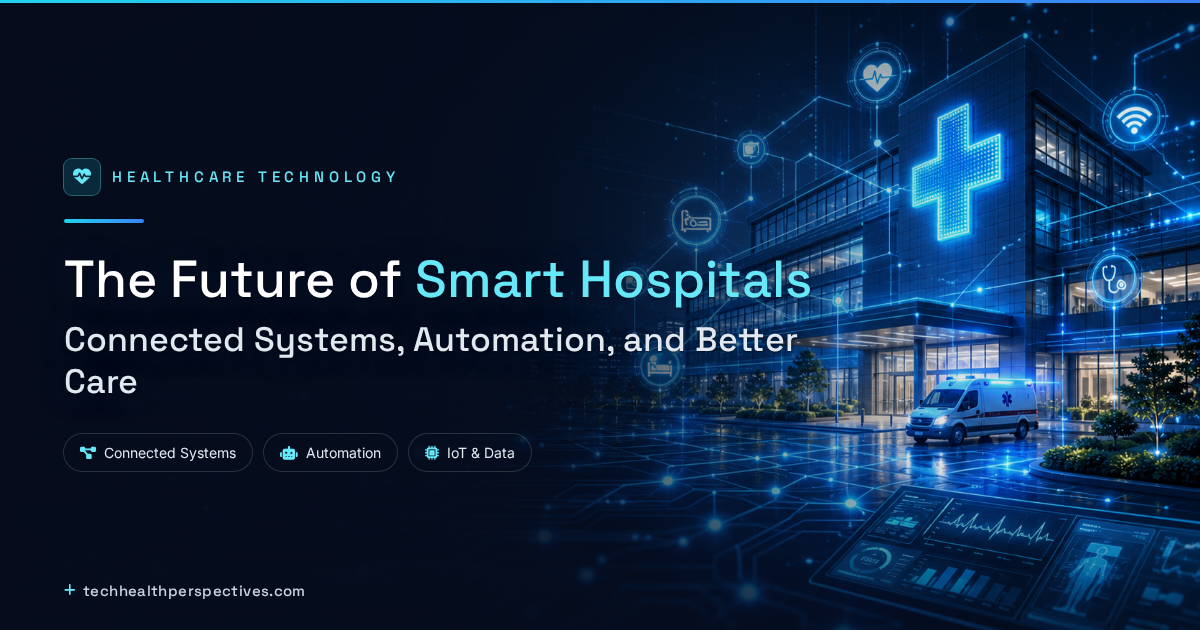
Hospitals have always been complex environments — hundreds of moving parts, thousands of decisions per shift, and a relentless demand for precision in situations where the margin for error is razor thin. What is changing now is not the complexity itself but our ability to manage it. Smart hospitals are redefining how care is delivered by weaving together connected devices, intelligent automation, and data-driven decision-making into a unified operating environment.
This is not a distant vision. It is already taking shape in health systems around the world, and the organizations that understand where the technology is heading — and what it demands of leadership — will be the ones that deliver better outcomes at lower cost.
A smart hospital is not simply one that has new equipment. It is an institution where clinical systems, operational infrastructure, and patient-facing technologies communicate with each other in real time — creating a continuous feedback loop that informs decisions at every level.
At its core, a smart hospital integrates three layers:
Connected devices and sensors — from bedside monitors and infusion pumps to HVAC systems and asset trackers — generate a constant stream of data about patients, equipment, and the physical environment.
Intelligent software platforms — including electronic health records (EHRs), clinical decision-support systems, and operational dashboards — aggregate that data, surface patterns, and deliver actionable insights to clinicians and administrators.
Automated workflows — triggered by predefined rules or machine learning models — reduce manual tasks, minimize human error, and accelerate response times for everything from medication dispensing to bed management.
When these layers work together, the result is not just a more efficient hospital. It is a fundamentally different care experience for patients and staff alike.
One of the most persistent problems in healthcare is fragmentation. A patient’s lab results live in one system, their imaging in another, their medication history in a third, and their insurance information in a fourth. Clinicians spend an extraordinary amount of time hunting for information that should be instantly available.
Connected healthcare systems solve this by creating interoperability across platforms — allowing data to flow seamlessly between departments, facilities, and even different health systems. The result is a unified patient record that follows the individual wherever they receive care.
The enabling technologies behind this shift include:
HL7 FHIR (Fast Healthcare Interoperability Resources) — an open standard that allows different software applications to exchange healthcare data in a structured, predictable format. FHIR has become the backbone of modern health information exchange.
Internet of Medical Things (IoMT) — the network of connected medical devices that continuously transmit patient data to centralized systems. From wearable cardiac monitors to smart IV pumps, IoMT devices are turning hospitals into real-time data environments.
Cloud-based infrastructure — which provides the scalable computing power and storage needed to process massive volumes of clinical and operational data without the limitations of on-premise servers.
The shift toward connectivity is not just a technology upgrade. It is a cultural one. It requires clinicians to trust data they did not personally collect, administrators to invest in infrastructure they cannot always see, and IT teams to manage security across an exponentially larger attack surface.
The word “automation” in healthcare still triggers anxiety among some professionals — the fear that machines will replace clinical judgment. In practice, the most effective automation in smart hospitals does the opposite: it removes the repetitive, low-value tasks that consume clinical time, freeing nurses and physicians to focus on the work that actually requires human expertise.
Robotic process automation (RPA) handles administrative workflows like prior authorization requests, claims processing, appointment scheduling, and discharge paperwork. These are tasks that follow predictable rules and consume hundreds of staff hours each month — hours that could be redirected toward patient care.
Clinical automation takes a more sophisticated form. Automated sepsis screening algorithms, for example, continuously analyze vital signs, lab results, and nursing assessments to flag patients at risk hours before symptoms become clinically obvious. Automated medication dispensing systems reduce pharmacy errors and ensure that the right drug reaches the right patient at the right dose.
Supply chain automation uses predictive analytics to forecast demand for consumables — gloves, syringes, surgical supplies — and trigger reorders before shortages occur. During the pandemic, hospitals with automated supply chain systems adapted far more quickly than those relying on manual inventory counts.
The key principle is augmentation, not replacement. The smartest hospitals design automation around the clinician’s workflow rather than forcing clinicians to adapt to the machine’s logic.
AI is the engine that makes many smart hospital capabilities possible. Its applications span clinical care, operations, and population health — and they are maturing rapidly.
Diagnostic imaging is one of the most advanced use cases. AI algorithms can now detect early-stage tumors, fractures, and retinal disease with accuracy that matches or exceeds human radiologists in controlled studies. These tools do not replace the radiologist — they serve as a second reader, catching findings that might be missed during a high-volume shift.
Predictive analytics models use historical and real-time data to forecast patient deterioration, readmission risk, emergency department surges, and staffing needs. Hospitals that deploy these models effectively can intervene earlier, allocate resources more precisely, and reduce costly downstream events.
Natural language processing (NLP) extracts structured data from unstructured clinical notes, enabling more complete coding, faster documentation, and richer data sets for research and quality improvement.
Conversational AI — chatbots and virtual assistants — handles patient inquiries, appointment management, symptom triage, and post-discharge follow-up, reducing call center volume and improving access for patients who prefer digital communication.
The challenge with AI is not capability — it is governance. Smart hospitals need clear frameworks for validating algorithms, monitoring for bias, ensuring transparency in automated decisions, and maintaining accountability when AI-informed actions affect patient outcomes.
Technology is only valuable if it improves the experience for the people who matter most — patients. In a well-designed smart hospital, patients notice the difference even if they never see the technology behind it.
Digital check-in and wayfinding eliminate the clipboard-and-waiting-room bottleneck. Patients register on their phones, receive real-time updates about wait times, and navigate the facility using GPS-enabled indoor mapping.
Smart patient rooms adjust lighting, temperature, and entertainment preferences automatically. Bedside tablets give patients access to their care plan, medication schedule, and educational materials — reducing the anxiety that comes from feeling uninformed.
Remote monitoring extends the hospital’s reach beyond its walls. Patients recovering at home wear connected devices that transmit vital signs to care teams in real time, enabling earlier intervention when recovery deviates from the expected trajectory. This is especially impactful for managing chronic conditions and reducing preventable readmissions.
Telehealth integration allows specialists to consult on complex cases without requiring the patient — or the specialist — to be physically present. In rural and underserved markets, this capability transforms access to care that was previously unavailable.
Smart hospitals do not just change technology — they change the workforce. As connected healthcare systems become standard, the skills that healthcare professionals need are evolving alongside them.
Nursing informatics has grown from a niche specialty into a critical function. Nurses who understand both clinical workflows and information systems are essential to designing, implementing, and optimizing the platforms that smart hospitals depend on.
Data analysts and data scientists are now as vital to hospital operations as financial analysts. These professionals build the models, dashboards, and reporting frameworks that turn raw data into actionable insight.
Clinical engineers and biomedical technicians manage an increasingly sophisticated ecosystem of connected devices — ensuring that sensors, monitors, and robotic systems are calibrated, secure, and interoperable.
For nurse practitioners and advanced practice providers navigating this evolving landscape, platforms like NP Collaborator offer valuable resources for professional development and collaboration — helping clinicians build the connections and credentials they need to lead effectively in technology-driven care environments.
Change management specialists help organizations navigate the human side of digital transformation — addressing resistance, redesigning workflows, and ensuring that technology adoption does not outpace staff readiness.
Every connected device is a potential entry point for a cyberattack. As hospitals become smarter, they also become more vulnerable — and the stakes in healthcare are uniquely high. A ransomware attack that locks clinicians out of the EHR does not just cost money. It can cost lives.
Smart hospitals must treat cybersecurity as a clinical priority, not just an IT concern. That means:
Encrypting data in transit and at rest across every connected system. Segmenting networks so that a breach in one area cannot cascade across the entire infrastructure. Implementing zero-trust security models that verify every user and device before granting access. Conducting regular penetration testing and incident response drills. Training every staff member — clinical and non-clinical — to recognize phishing, social engineering, and other common attack vectors.
The most sophisticated clinical technology in the world is worthless if it cannot be trusted to be available, accurate, and secure when a patient’s life depends on it.
The trajectory is clear, even if the timeline varies by institution. Over the next five years, several trends will accelerate:
Ambient intelligence — environments that sense and respond to occupants without requiring explicit interaction — will move from pilot programs to standard deployment. Patient rooms will detect falls automatically. Operating rooms will track instrument counts in real time. Hallways will adjust lighting based on occupancy and time of day.
Digital twins — virtual replicas of physical hospital environments — will allow leaders to simulate the impact of operational changes before implementing them. Want to know how adding ten beds to the ICU will affect emergency department throughput? Run it on the digital twin first.
Genomics integration will bring precision medicine into routine clinical workflows. Treatment plans will increasingly reflect a patient’s genetic profile, not just their symptoms and history.
Sustainability optimization will use smart building systems to reduce energy consumption, water waste, and carbon emissions — aligning hospital operations with broader environmental commitments.
Technology does not make a hospital smart. Leadership does. The health systems that are furthest along in this transformation share a common trait: executive teams that treat digital strategy as inseparable from clinical strategy.
Building a smart hospital requires capital investment, certainly — but it also requires vision, patience, and a willingness to redesign workflows that have been in place for decades. It demands honest conversations about what technology can and cannot do, and a commitment to measuring impact rather than simply counting implementations.
The future of connected healthcare systems belongs to organizations that see technology not as an end in itself but as a means to deliver safer, more efficient, more human care. The tools are available. The question is whether leadership is ready to use them.