Physical Address
304 North Cardinal St.
Dorchester Center, MA 02124
Physical Address
304 North Cardinal St.
Dorchester Center, MA 02124

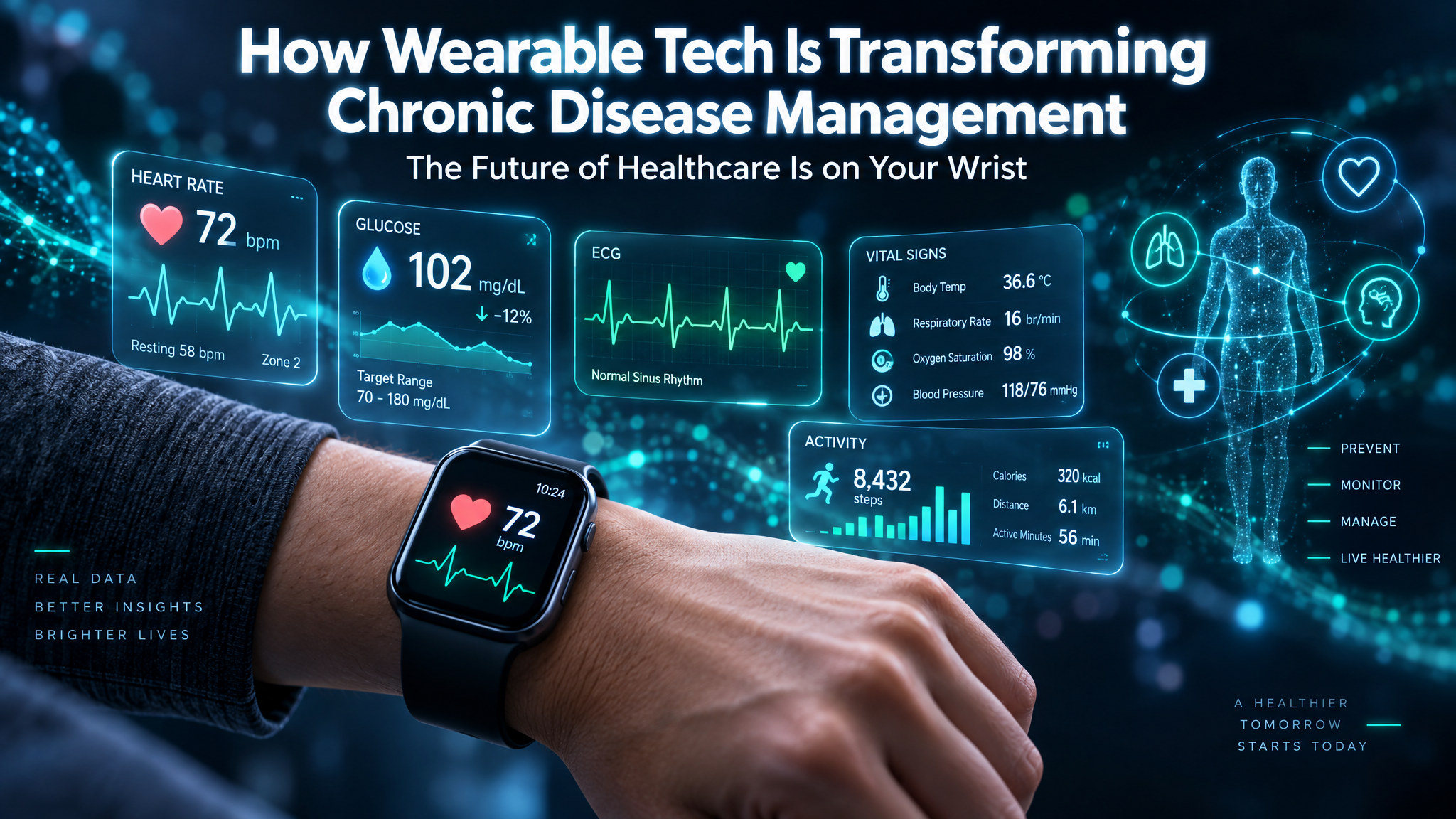
Wearable health technology has moved well beyond step counts and sleep scores. For people living with long-term conditions, connected devices are increasingly becoming a practical layer of everyday care: collecting information between appointments, revealing patterns that a short clinic visit can miss, and giving care teams a clearer prompt for timely action.
That shift matters because chronic disease management happens primarily at home, at work, and in the routines of daily life. Diabetes, cardiovascular disease, chronic respiratory illness, hypertension, and behavioral health conditions all require decisions made far from the exam room. The most useful wearables do not replace clinicians or diagnosis; they make those decisions more informed and make care more continuous.
A smartwatch can measure pulse trends, an adhesive sensor can track glucose around the clock, and a connected blood-pressure cuff can securely transmit readings to a clinical team. Together, these tools represent a fast-growing category of wearable health technology: devices worn on the body, or used at home alongside a connected app, to collect health data over time.
Traditional care is often episodic. Wearables add context between visits: overnight changes, medication effects, breathlessness during activity, or an irregular rhythm during a particular episode.
For patients, that can mean more agency. For providers, it can mean a richer clinical conversation. For health systems, it supports remote patient monitoring (RPM), preventive outreach, and care beyond office visits.
Wearables are not magic dashboards. Value depends on a suitable device, user training, and a process for acting on meaningful data.
Wearables use different sensors depending on the question they are designed to answer. Optical sensors can estimate pulse and oxygen saturation by analyzing light reflected through skin. Electrodes can record a single-lead electrocardiogram (ECG). Accelerometers and gyroscopes capture movement, gait, activity, and sleep-related patterns. Skin temperature, respiratory rate estimates, and electrodermal activity can add further context.
Continuous glucose monitors (CGMs) take a different approach. A small sensor placed under the skin measures glucose in interstitial fluid at frequent intervals and sends results to a receiver or smartphone. Some systems can share those readings with a care team or a trusted family member.
In a clinical setting, the key word is trend. A single wearable reading may be imperfect or affected by fit, motion, skin tone, perfusion, hydration, or user technique. Repeated measurements, interpreted alongside symptoms, medications, home logs, laboratory results, and a clinician’s judgment, can be far more informative.
Most devices move through a familiar workflow:
This is the foundation of chronic disease management tech. The objective is not to generate the most data; it is to identify the data that changes a decision. A useful RPM program defines which patients qualify, what baseline is expected, who reviews incoming information, what constitutes an escalation, and how urgent concerns are routed after hours.
Diabetes is one of the clearest examples of a wearable changing daily care. CGMs replace isolated finger-stick snapshots with a near-continuous view of glucose direction and variability. Patients can see whether glucose is rising or falling, recognize how meals, exercise, stress, illness, and sleep affect them, and receive alerts for low or high readings.
For clinicians, CGM reports can support a more productive medication review by showing time in range, recurring overnight lows, post-meal spikes, and the relationship between insulin dosing and activity.
The caveat is equally important: CGM readings can lag behind blood glucose when levels change quickly, and users need instructions on when a confirmatory finger-stick check or urgent care is necessary. Access, coverage, skin irritation, and the burden of wearing a sensor also remain real considerations.
Consumer watches and prescribed patches can detect pulse irregularities or record a single-lead ECG. These capabilities can help capture intermittent symptoms that may not occur during a clinic ECG, including palpitations that raise concern for atrial fibrillation (AFib).
An alert is not a diagnosis. Motion, poor contact, and other rhythms can produce misleading results, while not every device is cleared or intended to screen every person. The strongest workflow is one in which a patient knows what to do after a notification and a clinician can review a tracing or order confirmatory testing.
In selected patients, wearable data may also support conversations about resting heart-rate trends, activity tolerance, rehabilitation adherence, or symptom patterns. The technology is most valuable when it complements—not substitutes for—clinical evaluation, cardiovascular risk management, and evidence-based treatment.
Blood pressure is highly variable, and measurements taken outside the clinic can reveal patterns hidden by “white coat” effects or sporadic office readings. Connected upper-arm cuffs are currently the most established home-monitoring option because proper technique and device validation are essential to reliable readings.
Wrist-based and cuffless blood-pressure wearables are advancing, but users and organizations should be careful about assuming that every wellness product is accurate enough for treatment decisions. A validated device, the right cuff size, repeated readings, and a clinician-guided measurement plan matter more than novelty.
When used well, connected monitoring can help identify uncontrolled pressure earlier, support medication titration, and reinforce practical habits such as sodium reduction, physical activity, sleep, and medication adherence.
For people with chronic obstructive pulmonary disease (COPD) and related respiratory conditions, deterioration may show up first as a subtle change in routine: less movement, faster breathing, poorer sleep, a rising resting heart rate, or a change in oxygen saturation for patients who have been instructed to track it.
Wearables and connected devices can bring those signals together with symptom check-ins, pulse oximetry, inhaler-use data, or spirometry in some programs. This may help teams spot a possible exacerbation earlier and prompt a call to assess symptoms, reinforce an action plan, or arrange evaluation.
But respiratory data are especially context-dependent. Consumer oxygen readings can be less reliable in certain circumstances, and no wearable should be used to dismiss severe shortness of breath, chest pain, confusion, or other urgent symptoms. Clinical protocols must be explicit about what a reading can—and cannot—tell a patient.
Many wearables estimate sleep, activity, heart-rate variability, and physiologic arousal. These data may help users notice patterns around stress, recovery, alcohol use, exercise, or insomnia. In behavioral health settings, a simple check-in paired with passive signals may create useful openings for a conversation about mood, anxiety, burnout, or adherence to a care plan.
The limits deserve equal emphasis. A device cannot diagnose depression, anxiety, or stress from a biomarker alone. Heart-rate variability is influenced by many factors, and wellness scores may cause unnecessary worry if presented as clinical verdicts. The best use is reflective and supportive: identify trends, ask better questions, and connect people to appropriate care.
Wearables deliver their greatest impact through a care model, not through a device purchase. Physicians, nurse practitioners (NPs), nurses, pharmacists, respiratory therapists, diabetes educators, and care coordinators each may have a role in turning incoming readings into safe action.
A well-designed RPM program typically includes:
NPs are often central to this work, reviewing trends, assessing symptoms by phone or video, reinforcing self-management, and collaborating with physicians on treatment decisions. In collaborative practice states, NPs who manage remote-monitoring programs may also need their collaborative agreements in place; platforms like NP Collaborator can help them find and manage those physician partnerships efficiently.
The clinical skill is not merely reading a dashboard. It is distinguishing a signal from noise, applying the patient’s history and preferences, and closing the loop. A sustained upward blood-pressure trend may lead to a medication conversation; repeated low glucose alerts may trigger insulin education; a rhythm notification paired with dizziness may warrant faster evaluation. The wearable provides information, but care coordination turns information into care.
The promise of wearable health technology should be matched by thoughtful guardrails.
Health data can move among device makers, mobile apps, cloud services, monitoring vendors, and clinical records. Patients should understand what is collected, who can access it, whether it is used beyond direct care, and how they can revoke permissions. Health organizations need vendor review, secure integration, clear consent processes, and policies that minimize unnecessary data collection.
Not every wearable is a medical device, and even regulated devices have defined intended uses and limitations. Clinicians and consumers should look for validation relevant to the population and measurement, not assume that a general wellness score is clinically actionable. Good care plans also specify when to confirm a result with a standard device or clinical test.
A connected device is only useful if someone can obtain it, charge it, wear it comfortably, understand its feedback, and transmit data reliably. Cost, insurance coverage, broadband access, language, disability, health literacy, and smartphone availability can all widen disparities. Programs can reduce barriers by offering cellular devices when appropriate, multilingual support, training, alternative non-digital pathways, and human outreach when readings stop arriving.
Continuous monitoring can create too many notifications for patients and clinicians. Excess alerts can lead people to ignore a truly important signal—or to feel constantly surveilled. Thresholds should be individualized, alerts should be clinically meaningful, and teams should regularly evaluate whether their workflow is producing useful action rather than noise.
The next phase of chronic disease management tech will be less about a single sensor and more about connected, interpretable care. Multi-sensor devices may combine movement, sleep, temperature, rhythm, respiratory, and patient-reported data to identify meaningful changes earlier. Better interoperability could place concise, actionable summaries inside the clinical record instead of leaving data stranded in separate apps.
Artificial intelligence may help prioritize changes for human review, but it should augment clinical judgment, not operate as an opaque decision-maker. Credible systems must be transparent, tested across diverse populations, and monitored for bias and safety.
Future platforms may use an individual baseline to deliver clinician-approved coaching that reflects diagnosis, medications, goals, and access needs.
Wearables are changing chronic care because they bring the realities of daily life into the care conversation. From CGMs that reveal glucose patterns to ECG-capable devices that capture intermittent symptoms, the right tools can help patients and care teams move from occasional snapshots to more timely, informed decisions.
The technology works best when it is accurate, accessible, private, and embedded in a responsive clinical workflow. The future is better coordinated care around the person wearing it.