Physical Address
304 North Cardinal St.
Dorchester Center, MA 02124
Physical Address
304 North Cardinal St.
Dorchester Center, MA 02124

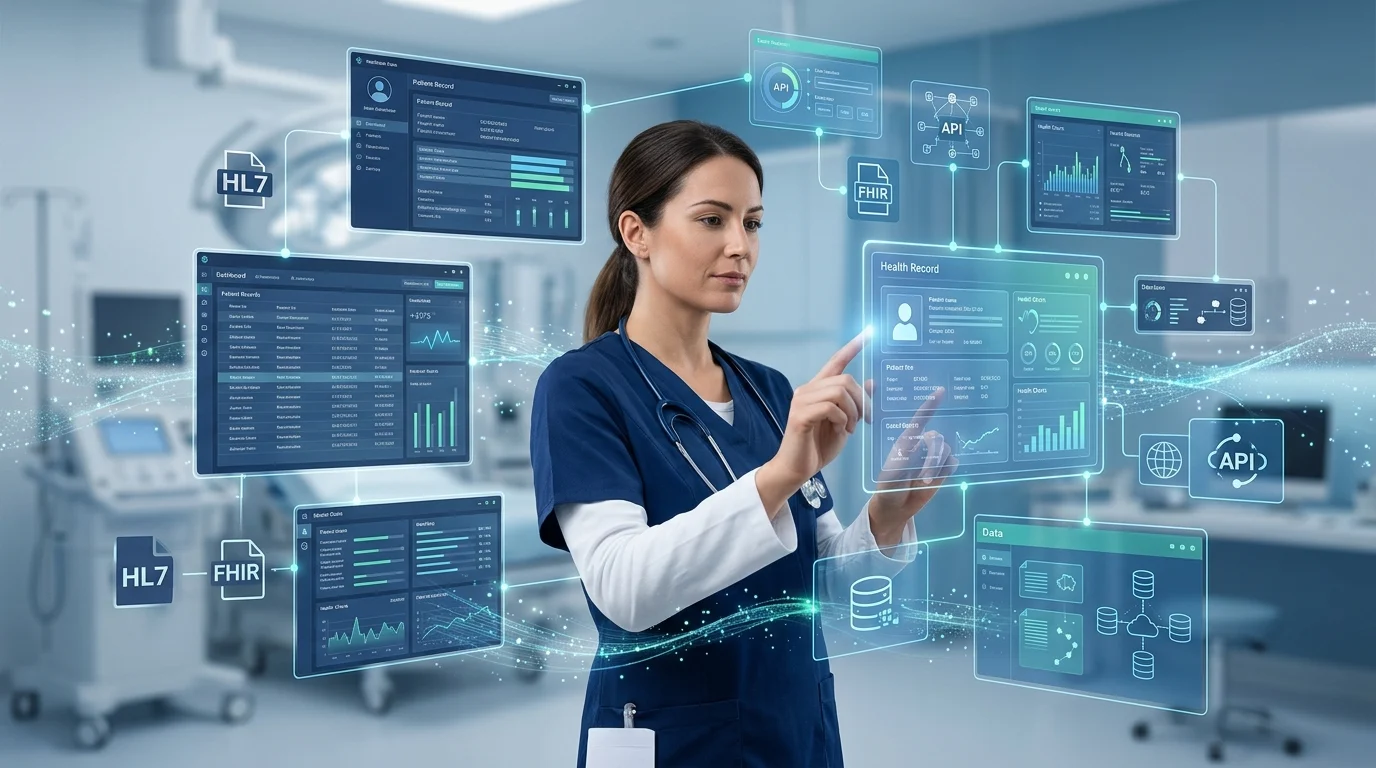
Imagine a patient walking into an emergency room after a car accident. The attending physician needs immediate access to the patient’s medical history—allergies, current medications, previous surgeries, and chronic conditions. But instead of retrieving this critical information within seconds, the emergency team spends valuable minutes searching across multiple hospital systems, clinics, and pharmacies that don’t communicate with each other. This scenario happens countless times daily across healthcare facilities worldwide, highlighting a fundamental problem: interoperability in healthcare remains fragmented despite decades of technological advancement.
Interoperability in healthcare refers to the ability of different information systems, medical devices, and software applications to seamlessly exchange, interpret, and use data in a coordinated manner. It’s the digital backbone that enables healthcare providers, organizations, and systems to work together efficiently, sharing patient information without barriers. Without it, patient care is compromised, costs skyrocket, and opportunities for better outcomes slip away.
In this comprehensive guide, we’ll explore what interoperability means, why it’s essential for delivering superior patient care, the standards that support it, and the challenges healthcare organizations face in achieving true healthcare data integration.
True interoperability in healthcare operates at multiple levels, each building upon the last to create a fully connected ecosystem. Understanding these levels is crucial for healthcare administrators and IT professionals tasked with modernizing their systems.
Foundational interoperability represents the most basic level of healthcare data integration. It establishes the fundamental ability for different systems to transmit and receive data. Think of it as ensuring that two computer systems can “talk” to each other at all—that cables are connected and communication protocols are established.
At this level, systems can exchange data without necessarily understanding its meaning. For example, a hospital might send patient record files to another facility, but the receiving system may not automatically interpret the data correctly. It’s progress, but incomplete.
Structural interoperability takes healthcare data integration a step further by standardizing how data is formatted and organized. When systems achieve structural interoperability, they can parse incoming data and understand its organization—identifying fields, data types, and relationships.
A patient’s medication list from System A will be recognized as a medication list by System B. The dates will be recognized as dates, dosages as numbers, and medication names as text. This level prevents data chaos and reduces manual re-entry, saving time and reducing errors.
Semantic interoperability represents the gold standard—systems don’t just receive data, they understand its meaning and clinical context. When a system receives a record showing “Lisinopril 10mg daily,” it comprehends this is an ACE inhibitor used for hypertension management, not just a random collection of characters.
This is where interoperability in healthcare achieves its true potential, enabling intelligent clinical decision-making, accurate medication reconciliation, and comprehensive patient history access.
Several critical standards have emerged to facilitate healthcare data integration across organizational boundaries.
HL7 has been the healthcare industry standard for decades. HL7 v2 remains widely implemented, defining how clinical and administrative data are structured and transmitted. However, HL7 v2 has limitations—it can be complex to implement and doesn’t naturally support semantic interoperability.
FHIR (Fast Healthcare Interoperability Resources) represents the new generation of healthcare data integration standards. Built on modern web technologies (RESTful APIs and JSON), FHIR is:
The Centers for Medicare & Medicaid Services (CMS) has mandated FHIR adoption for information blocking rules, accelerating industry-wide implementation.
The connection between interoperability in healthcare and patient outcomes isn’t theoretical—it’s clinically significant.
When providers have comprehensive access to patient history through integrated systems, they make more informed decisions. A cardiologist can see that a patient is already taking a blood thinner, preventing dangerous drug interactions. An oncologist can access previous imaging studies to track tumor progression over years rather than months.
Medical errors frequently stem from incomplete information. According to research, medication errors alone cost the healthcare system $40 billion annually. Healthcare data integration eliminates the most common cause: transcription errors and missing information.
Chronic disease management requires multiple specialists working in concert. Seamless interoperability ensures that a patient’s primary care physician, cardiologist, endocrinologist, and pharmacist all access current information, coordinating therapies rather than duplicating efforts or creating conflicts.
In emergency situations, every second counts. Integrated systems provide emergency physicians with immediate access to allergies, medications, previous procedures, and relevant medical history—potentially lifesaving information.
Redundant testing is rampant in fragmented systems. A patient transferred between facilities often undergoes repeated imaging, laboratory tests, and procedures because previous results aren’t readily accessible. Healthcare data integration eliminates this waste.
The Department of Veterans Affairs operates one of the most integrated healthcare systems in the world. Their Veterans Health Information Systems and Technology Architecture (VistA) enables seamless care coordination across 1,200+ facilities. This integration has contributed to the VA achieving among the lowest hospital readmission rates in the country—demonstrating the tangible benefits of true healthcare data integration.
Progressive health systems like Geisinger and Kaiser Permanente have invested heavily in interoperability infrastructure. These organizations demonstrate measurably better quality metrics, lower costs, and higher patient satisfaction—direct results of their commitment to healthcare data integration.
Modern patient portals, enabled by interoperable systems, allow patients to access their medical records, review test results, and communicate with providers. This transparency improves medication adherence and patient engagement—factors directly linked to better outcomes.
Despite decades of standardization efforts, healthcare interoperability remains incomplete. Several substantial obstacles persist.
Many healthcare organizations operate decades-old systems that predate modern standards. Retrofitting these legacy systems to support current standards is technically complex and expensive, often requiring parallel systems during transition periods.
Historically, some organizations resisted interoperability to maintain competitive advantages or prevent patient switching. While regulations now explicitly prohibit information blocking, cultural resistance in some institutions persists.
Healthcare data is sensitive, and interoperability increases attack surfaces. Organizations must balance connectivity with security, implementing robust encryption, authentication, and audit mechanisms—adding complexity to healthcare data integration efforts.
Healthcare remains diverse, with many specialized areas (veterinary medicine excluded, but thinking of pediatrics, rare diseases, mental health) having unique data needs. Finding consensus standards that accommodate this diversity is challenging.
Implementing true interoperability requires significant investment in technology, training, and process redesign. Smaller practices and rural facilities often lack resources for comprehensive modernization.
The trajectory is clear: healthcare is moving toward true interoperability, accelerated by regulatory pressure, technological advancement, and economic incentives.
Organizations increasingly adopt API-first strategies, making healthcare data integration a core architectural principle rather than an afterthought. This approach enables dynamic ecosystem connectivity as new providers and technologies emerge.
Cloud platforms simplify interoperability infrastructure, eliminating the need for complex point-to-point integrations. Blockchain technologies show promise for creating auditable, decentralized healthcare data networks with enhanced security.
As AI increasingly supports clinical decision-making, integrated data becomes essential. AI algorithms require comprehensive, normalized data across clinical contexts to deliver accurate predictions and recommendations.
Emerging models put patients at the center of their data, with individuals controlling access to their integrated health records across any healthcare provider. This shift will necessitate unprecedented interoperability.
Interoperability in healthcare isn’t a technology problem anymore—it’s a reality we’re building incrementally. Healthcare data integration is transforming from a distant aspiration to an operational necessity. Organizations embracing this transformation report better outcomes, lower costs, and improved provider satisfaction.
For healthcare administrators, the question isn’t whether to pursue interoperability but how quickly to implement it. For IT professionals, the path is clearer than ever: adopt FHIR-based architectures, invest in modern integration platforms, and commit to data standards.
The patient who arrives at an emergency room five years from now should have instant access to their complete medical history. The specialist who assumes care of a chronic disease patient should immediately understand their treatment trajectory. The data-driven healthcare system of the future depends on interoperability—and that future is arriving now.
The integration of healthcare systems isn’t just an operational efficiency—it’s a clinical imperative that directly impacts patient safety, quality, and outcomes. As healthcare technology continues evolving, organizations that prioritize healthcare data integration won’t just compete more effectively—they’ll deliver the coordinated, intelligent, patient-centered care that modern medicine demands.